Ensuring infusion perfection in every drop
At Burtons, we understand that precision can be the difference between recovery and complications, especially when it comes to fluid therapy. Yet across practices, a critical but often overlooked issue persists: the use of incompatible giving sets. These two factors, when not properly managed, can lead to dangerously inaccurate infusion rates, placing patient safety and even equipment longevity at risk.
To better understand the scale of this issue, our in-house team of technical experts conducted a controlled study, testing a range of infusion pumps and giving sets under consistent conditions. The objective being: to determine just how much variation in performance can occur due solely to equipment choice and maintenance, or the lack thereof.
This study reinforces a key message for clinical teams and decision-makers alike: regular calibration, servicing, and performance checks are not optional; they’re essential for maintaining equipment that delivers consistent and precise patient care.
Why fluid pumps are so important in practice
Infusion pumps have become essential tools in veterinary practices due to the increased accuracy and efficiency of fluid delivery over traditional methods. Understanding the significant role that they play in patient outcomes is crucial for making informed decisions about their maintenance.
Gráinne Kelly BSc (Hons) Cert VN ECC PG Cert VAA RVN – Burtons Equipment Consultant shares her insight into the real-world benefits of using fluid pumps over traditional manual methods:
“The advantage of using fluid pumps over the traditional drops/ml method is multifaceted. Fluid pumps reduce the risk of over- or under-infusing our patients compared to drops/ml. They are also much more accurate for smaller patients, who have smaller circulating volumes and therefore a reduced fluid resuscitation volume requirement.
Further to this, the use of fluid pumps offers a range of alarms which help prevent iatrogenic trauma. An alarm we often hear in practice is the occlusion alarm. This can alert us to the fact that the IV catheter is no longer in place and the fluid is being administered to the surrounding tissues of the catheter site, rather than contributing to intravascular volume/fluid resuscitation. This is not only unhelpful to the patient’s fluid requirements but can also be an extremely painful condition.
Furthermore, fluid pumps offer us a wealth of therapy programmes, including VTBI (Volume to Be Infused), where a set volume can be programmed to allow for precise, limited fluid administration. This is helpful when administering drugs or other medications, where an overdose may be harmful.
The use of pumps also allows us to use the bolus function, whereby we can increase the rate of fluid administered for a set volume or period of time before returning to a set rate. This is particularly useful for analgesic CRIs or fluid resuscitation in critically ill patients, where the use of GDT (Goal Directed Therapy) has become the recommended approach to treating hypovolaemia.”
The testing process
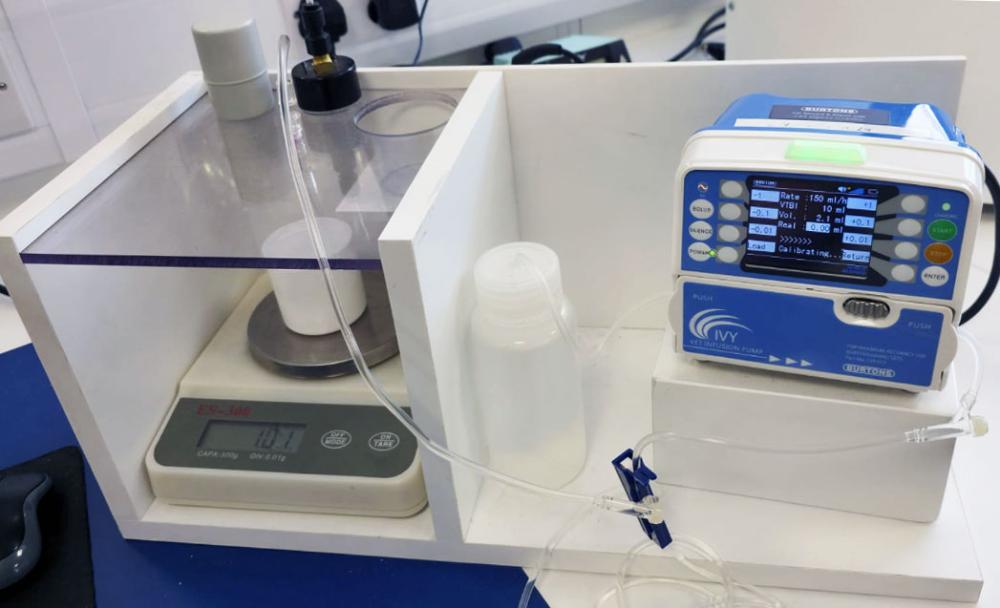
To ensure accuracy and consistency, each test run followed a standardised process. A selection of pumps, varying in age and condition, were individually calibrated to each giving set. Using distilled water maintained at a stable temperature of 21–23°C, 10ml was infused at a rate of 300ml/hour over a two-minute interval. The infused volume was then measured on a precision scale accurate to 0.01g. To avoid skewed results caused by tube compression, a fresh section of tubing was used for each repeat test. This method allowed accurate data to be collected. The full testing process took three days to complete and was carried out, in-house, by Baz Weller, Burtons Technical Support & Maintenance Specialist. The test provided a clear performance comparison across a wide range of giving sets and infusion pumps of varying conditions.
What did the test results show us?
The chart below illustrates the performance variation during testing of multiple infusion pump models across five separate test runs. Each group of bars represents four different infusion pumps, tested using the same calibration procedures. The target fluid volume was 10ml, which is marked by the horizontal blue line. The results revealed significant variability. Some pumps consistently delivered values close to the target, while others fluctuated noticeably between runs. The lowest amount observed was 8.8ml, which is 12% below the target. While the highest was 10.8ml, which would be 8% above the target. That 2ml difference represents a 20% spread relative to the target volume. Under-or over-infusions can have a significant impact on the patient, especially if they are very small or fragile.
This inconsistency highlights two critical issues
1. Giving set compatibility
Using giving sets that are not fit for purpose leads to inconsistent flow rates, even when used with calibrated pumps.
2. Pump condition and calibration
Despite using the same giving set, different pumps, and even the same pump across multiple runs, delivered varying results. Mechanical wear, sensor drift, and uncalibrated software contribute to these fluctuations.
These findings highlight the importance of routine servicing and calibration, which not only ensure flow rate accuracy but also detect early signs of pump degradation. By addressing both equipment compatibility and maintenance, clinicians can reduce the risk of under- or overdosing, ultimately safeguarding patient outcomes and improving clinical reliability.
“Accurate fluid delivery from an infusion pump depends on two critical factors: regular calibration and the use of a reliable giving set. Calibration ensures that the pump delivers fluid volumes within specified tolerances. Without routine calibration, discrepancies between the programmed and actual delivery rates can lead to significant dosing errors.” – Baz Weller - Technical Support & Maintenance Specialist, UK & International
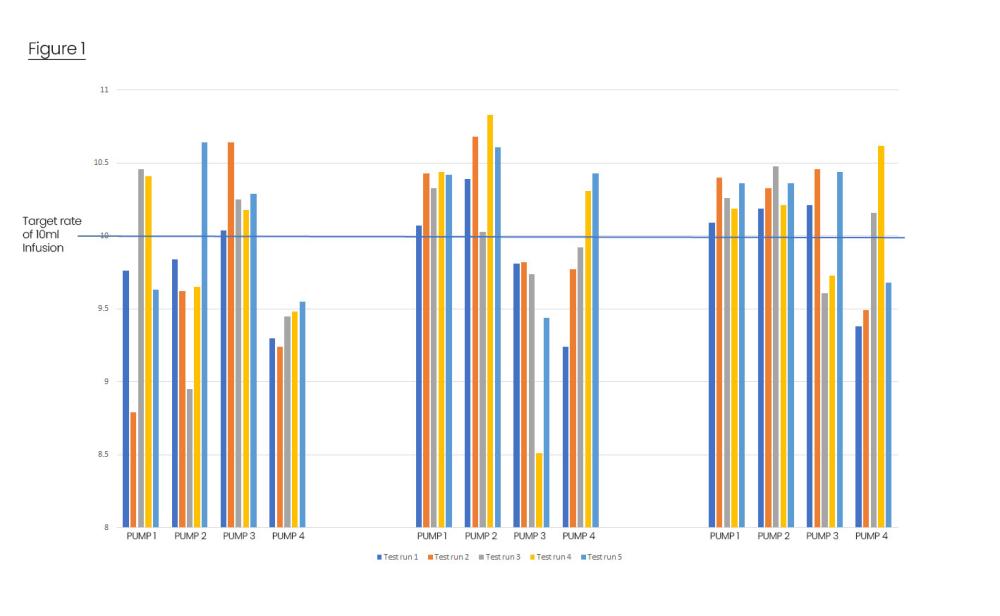
Figure 1: Each of the four pumps shown was tested using identical calibration procedures to ensure maximum accuracy. This graph highlights the significant variation in fluid delivery when gravity-fed lines are used instead of pump-compatible giving sets across pumps of different ages and conditions. The results demonstrate the importance of using high-quality, pump-specific giving sets, as well as the importance of the pump’s condition.
The importance of using high-quality, fit-for-purpose giving sets
Through detailed in-house testing, we demonstrated that the quality and compatibility of giving sets dramatically impact infusion accuracy and pump performance. High-quality, pump-compatible sets consistently delivered results within a ±2% tolerance, ensuring reliable fluid delivery. In contrast, cheaper or gravity-fed sets often fell well outside acceptable limits, sometimes up to ±40% deviation, and showed poor repeatability (see below graph). These poor-quality sets also placed increased strain on pumps, especially older or less powerful units, leading to premature failures. The data clearly show that selecting the right giving set is not just about cost, it's about precision, safety, and long-term equipment reliability.
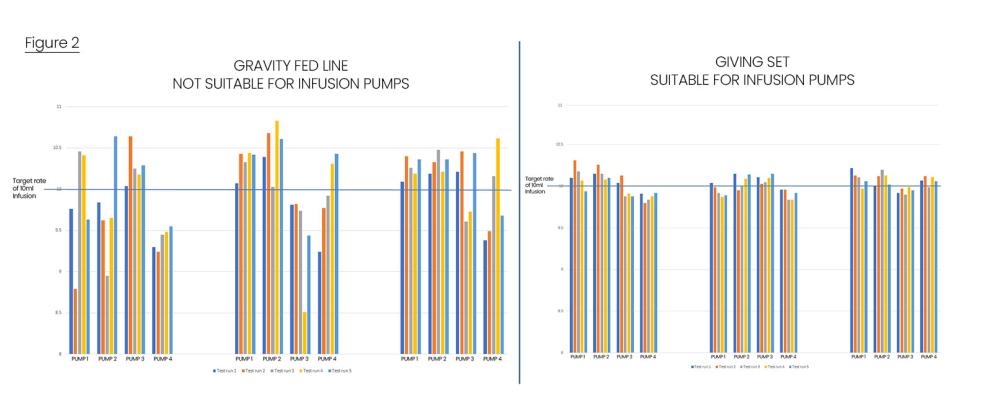
Figure 2: Each of the four pumps shown was tested using identical calibration procedures to ensure maximum accuracy. This graph compares the significant variation in fluid delivery between unsuitable gravity-fed lines and suitable pump-compatible giving sets across pumps of different ages and conditions. The results demonstrate the importance of using high-quality, pump-specific giving sets.
“The giving set used is also as important, using a set that is too wide, too thin, material used in its manufacture is too tough, then the pump can’t push enough fluid through, or may push through too much. If you want accurate infusion quantities, you need to find the right set and ensure the pump you put it in is set up for it. Repeatability of results is crucial; a poor giving set will give a wide range of fluid amounts, no matter how many times you calibrate it. Using an unsuitable gravity set can damage your pump. If it fails to compress the tube, it will put lots of stress on the components inside. In the end, it will cost you more in repairs.” – Baz Weller -Technical Support & Maintenance Specialist, UK & International
What happens if infusion pumps aren't serviced regularly?
The risks to your patients can escalate quickly. Without regular calibration and maintenance, infusion pumps may begin to deviate from their intended delivery rates, sometimes by alarming percentages. Even a seemingly small percentage discrepancy, such as 5–10%, can alter the volume of fluids or medications a patient will receive.
For a small, fragile or critically ill animal, this might mean receiving too little of a life-saving treatment, or too much of a drug, potentially leading to toxicity.
In the high-stakes environment of veterinary care, where precision translates to safety and efficacy, these inaccuracies are not just technical faults; they can also be clinical risks. Over time, lack of servicing can also increase the likelihood of infusion pump failure or alarm malfunctions, leading to missed occlusions or unnoticed interruptions, and may eventually lead to the pump needing to be replaced.
Regular servicing protects your equipment investment and, most importantly, protects your patients.
Conclusion
The results of our study leave no doubt. Accuracy and reliability in infusion therapy hinge on two critical factors: using high-quality, compatible giving sets and maintaining a programme of routine calibration and servicing.
“Routine servicing and calibration of infusion devices are essential for maintaining device accuracy in both flow rates and dosage delivery. Our recent research demonstrates that maintenance programmes help identify potential performance reliability concerns—such as sensor variance, mechanical wear and tear, and software inaccuracies—thereby preventing potential under- or overdosing. Routine calibration ensures compliance and provides reassurance to the operator regarding performance repeatability, ultimately safeguarding patient safety.” – Grant Kayes - Burtons Service Director
With patient safety and treatment precision at risk, regular calibration and the right equipment choices are not just optional; they are essential to delivering the high standard of care every patient deserves.
Our recommendations
It's important to note that the physical characteristics of the giving set, particularly the Shore hardness (material hardness) of the tubing, can significantly impact infusion accuracy. Using a giving set with the incorrect Shore hardness can result in unreliable flow rates, even with a well-calibrated pump. That’s why all Burtons infusion pumps are calibrated specifically to work with our SuperBlue Burtons Giving Sets, which are engineered with the ideal Shore hardness for optimal performance. This ensures consistency and compatibility across our range, so you can switch between giving set types with confidence. For best results, we recommend recalibrating your infusion pump every 6–12 months to maintain peak accuracy and safeguard patient care.
If you are concerned about the accuracy of your pump or giving sets, you can contact our service department here.

Share on Facebook

Share on X

Share on Pinterest

Share on LinkedIn
Related Products

Burtons EN-V5+ Infusion Pump Kit
From €760.04 €617.92

Burtons EN-V3 Infusion Pump
€607.73
€494.09

500 Giving Sets + Free Burtons EN-V3 Infusion Pump
Regular Price
€1,884.38
Now
Discounted Price
€898.86
€730.78
Need Some Advice?
Our team are on hand
Mon–Fri, 8.30am–5.00pm
Talk to us on our live chat
Or call/Whatsapp us on
Working late?
Popular Posts